

Tenants in Dubai have clear protections under the emirate’s tenancy law, but most people only learn about them when a dispute starts. This guide to tenant rights in Dubai explains the main law, why Ejari matters, the rules on rent increases, how eviction notices work and where to go if you disagree with your landlord. It is general information, not legal advice. Sources were checked on 13 November 2026.
The Law Behind Tenant Rights
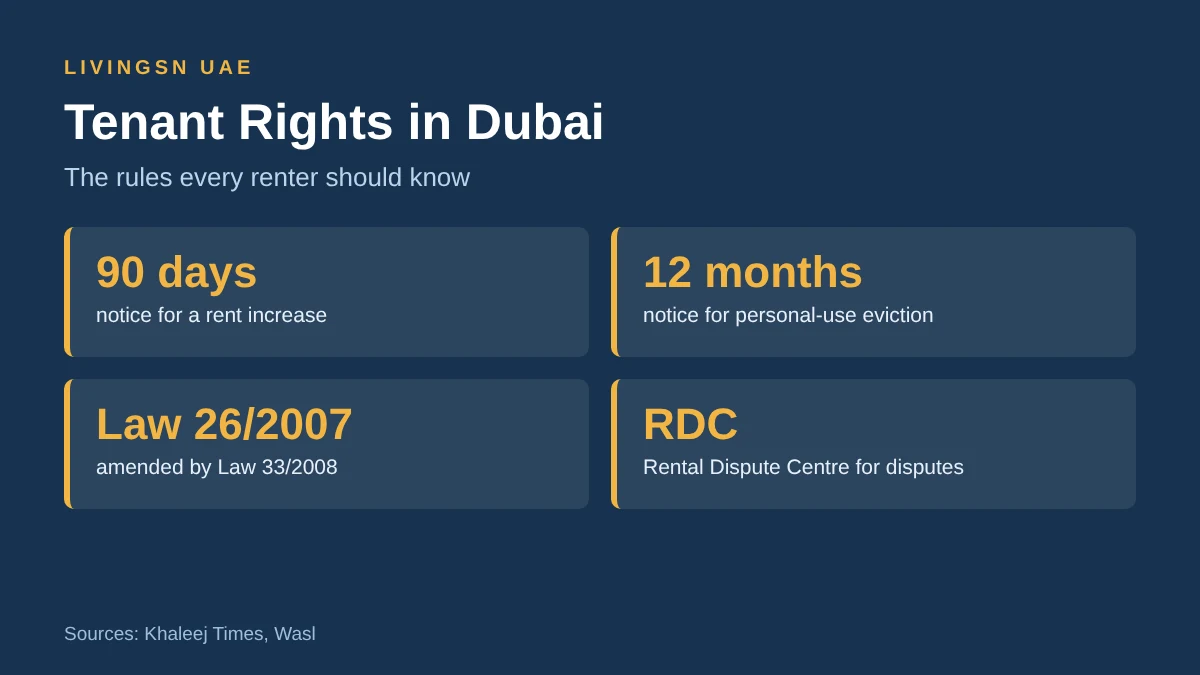
Khaleej Times’ explainer on the 12-month eviction notice cites Law No. 26 of 2007 (the Dubai tenancy law) and Law No. 33 of 2008, which amended it. These apply to rent contracts in Dubai. Other emirates have their own rules, so do not assume the same terms apply elsewhere.
Register Your Contract
Article 4(2) of the law says rent contracts shall be registered with RERA, which is what Ejari does. Khaleej Times notes that the law does not say whether an unregistered contract is valid, and that the Rental Dispute Centre may still accept a case without Ejari. Do not rely on that: register the contract, keep the certificate and see our Ejari renewal guide.
Rent Increases
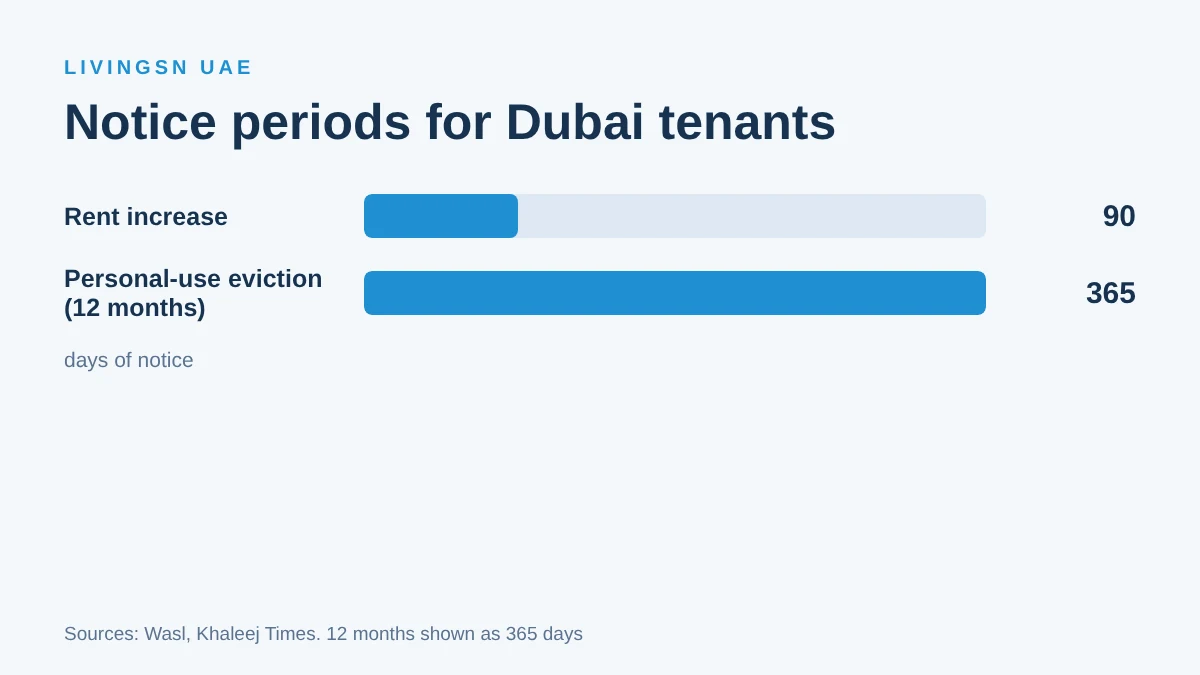
Landlords must give written notice of an increase and cannot go above the rental index limits. Wasl explains a 90-day notice and bands from 0% to 20%; our guide to Dubai rent increase rules has the full table and a worked example.
Eviction and Notice
A landlord cannot simply ask you to leave. Khaleej Times quotes Article 25(2)(c) of the amended law: to retake the property for personal use at contract expiry, the landlord must notify the tenant of the reasons at least 12 months before the eviction date, and the notice must be served through a notary public or by registered mail. The owner must also prove they own no other suitable property. The law lists other grounds as well, so read it or take advice for your situation.
| Situation | Notice or step | Source |
|---|---|---|
| Rent increase at renewal | 90 days’ written notice | Wasl |
| Landlord retakes property for own use | 12 months, by notary public or registered mail | Khaleej Times (Article 25(2)(c)) |
| Property sold to a new owner | Tenancy continues (Article 28, as described) | Khaleej Times |
Early Exit and Compensation
A landlord may offer compensation for leaving early. Khaleej Times describes this as an amicable settlement option, not a statutory entitlement, so get any agreement in writing.
If You Have a Dispute
- Collect your contract, Ejari certificate, payment receipts and messages.
- Reply in writing and keep copies of notices, noting the date received.
- Try to settle with the landlord in writing.
- If it fails, take advice and consider filing with the Rental Dispute Centre.
Tenant Rights In Dubai: Key Takeaways
The main points on tenant rights in dubai are simple: use official or clearly sourced figures, compare real numbers, and confirm details before you decide. If you want more detail on tenant rights in dubai, the related guides below cover each step. Bookmark this page on tenant rights in dubai and re-check the linked sources, because rules and prices change.
Frequently Asked Questions
Which law covers tenants in Dubai?
Law No. 26 of 2007, as amended by Law No. 33 of 2008, according to Khaleej Times.
How much notice must a landlord give to evict a tenant for personal use?
Article 25(2)(c) requires at least 12 months’ notice, served through a notary public or by registered mail.
Does the tenancy end if the landlord sells the property?
Khaleej Times describes Article 28 as continuing the tenancy after a change of ownership. Check your contract and take advice.
Is Ejari compulsory?
The law says rent contracts shall be registered with RERA. The Rental Dispute Centre may still accept a case without Ejari, but you should register anyway.
Where do rent disputes go?
To the Rental Dispute Centre. Get legal advice before you file.
Related Reading and Sources
- Dubai Rent Increase Rules
- Ejari Renewal in Dubai
- How to Find an Apartment in Dubai
- Law and eviction notice: Khaleej Times, 12-month eviction notice explainer.
- Rent increase: Wasl, rental calculator explainer.
- Check your contract is registered on Ejari.
- Keep every notice and receipt.
- Take legal advice before replying to an eviction notice.
Agent with stock to list?
Premium plan: AED 1,000 for 2 months, 60 properties and 10 featured listings.
Want to see live listings?
Browse homes for rent on LivingSN and compare prices by area.



[…] The landlord must give written notice 90 days before the renewal date if they want to change the rent. Without a proper notice, you can challenge the increase. Keep every message and letter, and note the date you received it. For eviction notice rules, which are different, see our tenant rights guide. […]
[…] Ejari is the record you need for disputes, utility connections and many visa processes. See our tenant rights guide for […]
[…] Keep copies of every document and receipt, and know your tenant rights. […]
[…] Bayut says Ejari registration is an essential responsibility for landlords, property managers and brokers, with fees of AED 177.75 online or AED 219.75 in person; see Ejari renewal. Engel and Volkers says the residential rental commission is typically 5% of the annual rent, paid by the tenant. Know the tenant’s side too: read tenant rights in Dubai. […]