

Security deposit rules for rental flats in India confuse tenants and landlords alike, because the amount, the refund date and the deductions differ from one city and one agreement to the next. This guide explains what the Model Tenancy Act, 2021 suggests, why many states have no fixed cap, what a landlord can deduct, how long a refund should take and how to protect your deposit with a written agreement. Sources were checked on 7 November 2026.
Security Deposit Rules for Rental Flats in India: Law vs Practice
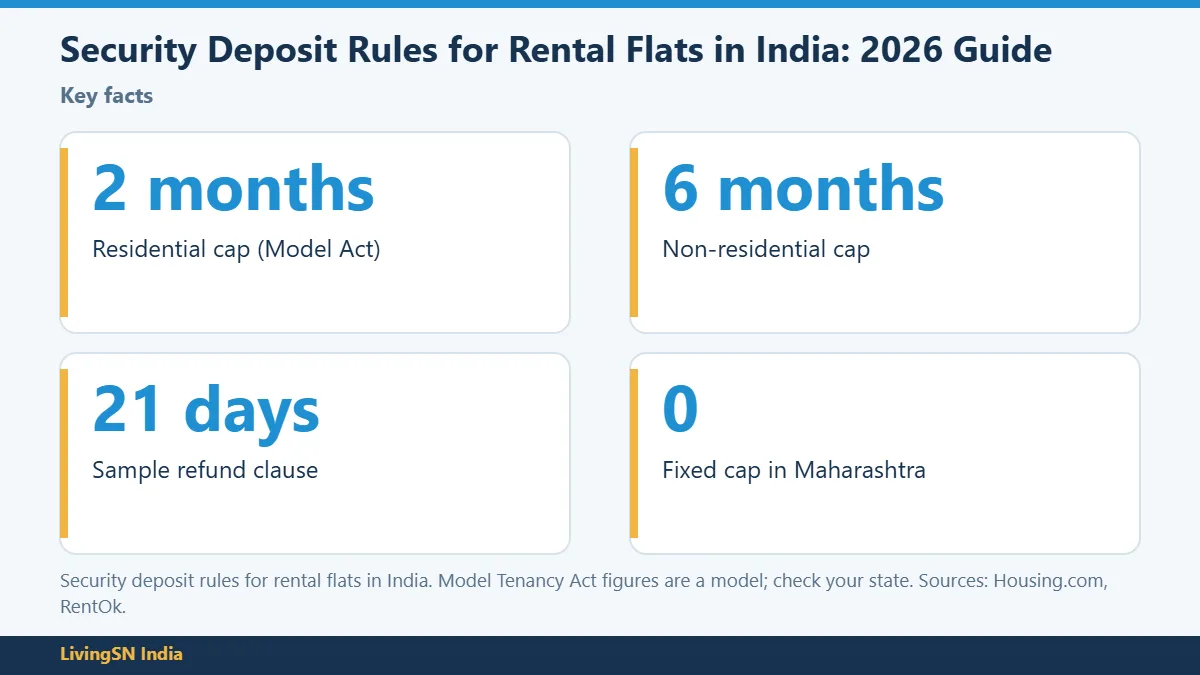
The main reference for security deposit rules for rental flats in India is the Model Tenancy Act, 2021. Housing.com says it limits the deposit to two months’ rent for residential property and six months’ rent for non-residential property. The Act is a model for states, so it binds only where a state has adopted it, as RentOk points out.
In practice the position varies. RentOk says there is no fixed statewide statutory cap in Maharashtra, which covers Mumbai and Pune, and that deposits in Delhi and Hyderabad largely depend on the tenancy agreement. For Bengaluru it only says deposits of “several months’ rent” are common. Housing.com adds that landlords in some metros, such as Delhi and Mumbai, have demanded more than two months’ rent. The security deposit rules for rental flats in India therefore depend heavily on where you live. A news report on a Bengaluru landlord who asked for a ₹5 lakh deposit on a ₹40,000 flat shows how wide the gap can be.
| Question | Model Tenancy Act, 2021 | Where it is not adopted |
|---|---|---|
| Residential deposit | Up to 2 months’ rent | Set by agreement; no fixed cap in Maharashtra |
| Non-residential deposit | Up to 6 months’ rent | Set by agreement |
| Binding on landlords? | Only where the state adopts it | State rent law and your agreement apply |
How Much Security Deposit Is Normal?
The honest answer is that it depends on the city, the locality and how much demand the flat has. We could not find a single reliable, up-to-date source that lists typical deposit months for every Indian city, so we do not quote one. Instead, use three checks. First, ask what similar flats in the same building or society have recently asked. Second, compare the deposit with the two-month Model Tenancy Act benchmark and ask the landlord to justify any large gap. Treat the security deposit rules for rental flats in India as a negotiating benchmark, not a guarantee. Third, remember that a larger deposit is money you will wait to get back, so weigh it against a lower monthly rent.
When you search flats for rent, note the deposit on every listing so you can compare. Our guides to Goregaon East and Santacruz East show how to read rents and costs together.
Refund Rules: Timing and Allowed Deductions
Housing.com says a deposit should be refunded within a specified period such as one or two months, usually after the landlord inspects the property. Its sample clause and FAQ use 21 days after the lease expires. The deposit is fully refundable when the agreement ends and is not renewed.
A landlord can deduct unpaid rent or utility charges, the cost of repairing damage the tenant caused, and costs for unfulfilled obligations such as an agreed notice period, subject to state law, according to RentOk. Normal wear and tear cannot be deducted. RentOk adds that routine repainting and normal furniture ageing are the landlord’s responsibility.
| Usually allowed | Usually not allowed |
|---|---|
| Unpaid rent and utility bills | Routine repainting |
| Repairs for damage the tenant caused | Normal wear and tear |
| Notice-period shortfall, if agreed in writing | Deductions with no bill or proof |
How to Protect Your Security Deposit
These steps work under any version of the security deposit rules for rental flats in India, because evidence and a written agreement decide most disputes.
- Write it in the agreement. State the amount, whether it is interest-free, the refund period and the list of allowed deductions. Our rent agreement checklist shows where this clause belongs.
- Pay by bank transfer. Keep a dated receipt that mentions the purpose of the payment.
- Record the flat’s condition. Take dated photos and videos of every room and fitting on move-in day, and share them with the landlord.
- Clear dues before you leave. Pay rent, maintenance and utility bills and get written confirmation.
- Do a joint inspection. Walk through the flat with the landlord on the last day and agree any deduction in writing.
- Ask for the refund date in writing. Follow up on the date stated in the agreement.
If the Landlord Does Not Return the Deposit
Housing.com describes a three-step route: negotiate with the landlord, send a legal notice if that fails, and file a civil case to recover the money if there is still no response. It warns that court cases can take years, though some finish within months, so keep your agreement and deposit receipt ready. Because the Model Tenancy Act proposes rent authorities and courts for tenancy disputes, check whether your state has set them up. Whatever the security deposit rules for rental flats in India say in your state, receipts and photos carry the most weight. This is general information, not legal advice; speak to a lawyer for a specific case.
For Landlords: Keep the Deposit Fair and Clear
Landlords benefit from following the security deposit rules for rental flats in India closely. A clear, reasonable deposit helps you rent faster. Match the deposit to local practice, explain deductions in the agreement, and keep bills for any repair. Owners who want to rent out quickly can follow our 9-step landlord checklist.
Frequently Asked Questions
What are the security deposit rules for rental flats in India?
The Model Tenancy Act, 2021 suggests a residential deposit of up to two months’ rent and a non-residential deposit of up to six months’ rent, but it applies only where a state adopts it. Elsewhere the amount, refund date and deductions depend on the agreement and state law.
How many months of security deposit is normal in India?
It varies by city and locality. Maharashtra has no fixed statewide cap, and Delhi and Hyderabad depend largely on the agreement. Compare similar flats nearby and use the two-month Model Tenancy Act figure as a benchmark.
How long does a landlord have to return the security deposit?
No single national period applies. Housing.com says refunds usually happen within one or two months after inspection, and its sample clause uses 21 days after the lease ends. Write the exact refund date in your agreement.
What can a landlord deduct from the security deposit?
A landlord can deduct unpaid rent and utility charges, repair costs for damage caused by the tenant and costs for unfulfilled obligations agreed in writing. Normal wear and tear cannot be deducted, according to Housing.com and RentOk.
Is interest payable on a rental security deposit?
Housing.com does not mention interest, and security deposits are normally interest-free in India unless the agreement says otherwise. State the position clearly in the agreement.
What should I do if my landlord keeps my deposit?
Negotiate first, then send a legal notice, and if there is no response consider a civil case to recover the deposit, as described by Housing.com. Keep the agreement, the payment receipt and move-in photos as evidence, and take legal advice.
More rental guides: Flat for Rent in New Delhi: Cost, Locations & Tenant Tips for 2026; Best Areas to Rent a Flat in Noida in 2026; Buying vs Renting a Flat in India 2026.
Related Reading and Sources
- Flat for Rent in New Delhi: Cost, Locations & Tenant Tips for 2026
- Best Areas to Rent a Flat in Noida in 2026
- Buying vs Renting a Flat in India 2026
- Rent Agreement in India: Format, Registration and Tenant Checklist
- How to Rent Out Your Flat Fast in India: 9-Step Landlord Checklist
- Tenant Verification for Landlords: Steps, Documents, Police Form
- Legal points: Housing.com, laws related to security deposit.
- State position and deductions: RentOk.
- Model Tenancy Act, 2021: PRS Legislative Research.
- Bengaluru deposit example: The Realty Today.
- Ask what similar flats nearby charge and compare with the two-month benchmark.
- Write the amount, refund period and allowed deductions into the agreement.
- Take dated move-in photos and pay the deposit by bank transfer.
Looking for a flat?
See current flats for rent across Indian cities, then agree the deposit in writing.
Browse flats for rentOwn a flat to rent out?
List it free for 2 months: up to 10 properties and 1 featured listing.
Start free trial


Join The Discussion