

Tenant verification for landlords is the process of confirming who your tenant is before they move in, and in many parts of India it is also a legal duty filed with the local police. Skipping it exposes you to risk if the tenant turns out to be unreliable or involved in an offence. This guide explains the steps, lists the documents, covers extra checks that go beyond the police form and shows common mistakes. It is general information, not legal advice, and rules differ by city and state. Sources were checked on 7 November 2026.
Why Tenant Verification for Landlords Matters
RentOk says the main purpose of police verification is to confirm that a tenant has no criminal history, to protect your property and the neighbourhood and to give you legal protection. It says that in many parts of India it is a mandate rather than a recommendation, and that non-compliance can lead to fines or even imprisonment. The source does not name amounts, durations or legal sections, so check your local police order or ask a lawyer.
Verification also helps if something goes wrong later, because you can show the police and the society that you took reasonable steps. It does not replace a written rent agreement; you need both.
Documents Needed for Tenant Verification
| Document | From | Notes |
|---|---|---|
| Filled verification form | Local police website | Includes tenant and landlord details |
| Signed rent agreement | Both parties | Attach a scan |
| Tenant ID proof | Tenant | Aadhaar, voter ID, passport or driving licence |
| Tenant permanent address proof | Tenant | Utility bill, bank passbook or statement, or passport |
| Passport-size photograph | Tenant | Recent |
| Landlord ID proof | Landlord | Aadhaar, PAN, passport or another valid government ID |
The list follows RentOk’s guide. Some police portals ask for more, such as the property address proof or an owner’s property document, so read the form before you start.
7 Steps for Tenant Verification for Landlords
- Screen the applicant first. Ask for ID, employment details and a short introduction before you share the flat’s full address.
- Collect documents. Take clear copies of ID, address proof and a photograph, and tell the tenant why you need them.
- Sign the rent agreement. Use a stamped written agreement; see our checklist.
- Open the police portal. Go to your state or city police website and find the tenant verification section.
- Fill and upload. Enter tenant and landlord details, upload scans and submit; pay any fee shown.
- Track the application. Use the reference ID, and download the report or acknowledgement when it arrives.
- Keep records. Save the agreement, ID copies, acknowledgement and every rent receipt in one folder.
RentOk describes the offline method as visiting the local police station and following up manually, which can involve queues.
Extra Checks Beyond the Police Form
The police form is the legal step, but it does not tell you whether a tenant will pay on time. These practical checks are our recommendations rather than legal requirements.
- Match the ID to the person. Compare the photo ID with the tenant at the meeting.
- Confirm employment. Ask for an offer letter or recent payslip, or call the HR number on the company website.
- Call a previous landlord. Ask about rent payment and how the flat was kept.
- Check who will live there. Record the names of all occupants in the agreement.
- Review the deposit terms. Follow our security deposit guide.
Tell the tenant about the process and get their consent, and consider re-verification for long tenancies, as RentOk suggests.
Mistakes Landlords Make
- Renting on a handshake or WhatsApp message, with no agreement.
- Accepting ID copies without checking the original.
- Thinking the broker handled police verification when nobody filed it.
- Not recording who lives in the flat.
- Throwing away the police acknowledgement or rent receipts.
Frequently Asked Questions
Is tenant verification mandatory in India?
RentOk says that in many parts of India it is a legal mandate and non-compliance can lead to fines or imprisonment. Rules differ by state and city, and the source cites no specific section, so confirm with your local police or a lawyer.
Who is responsible for police verification, landlord or tenant?
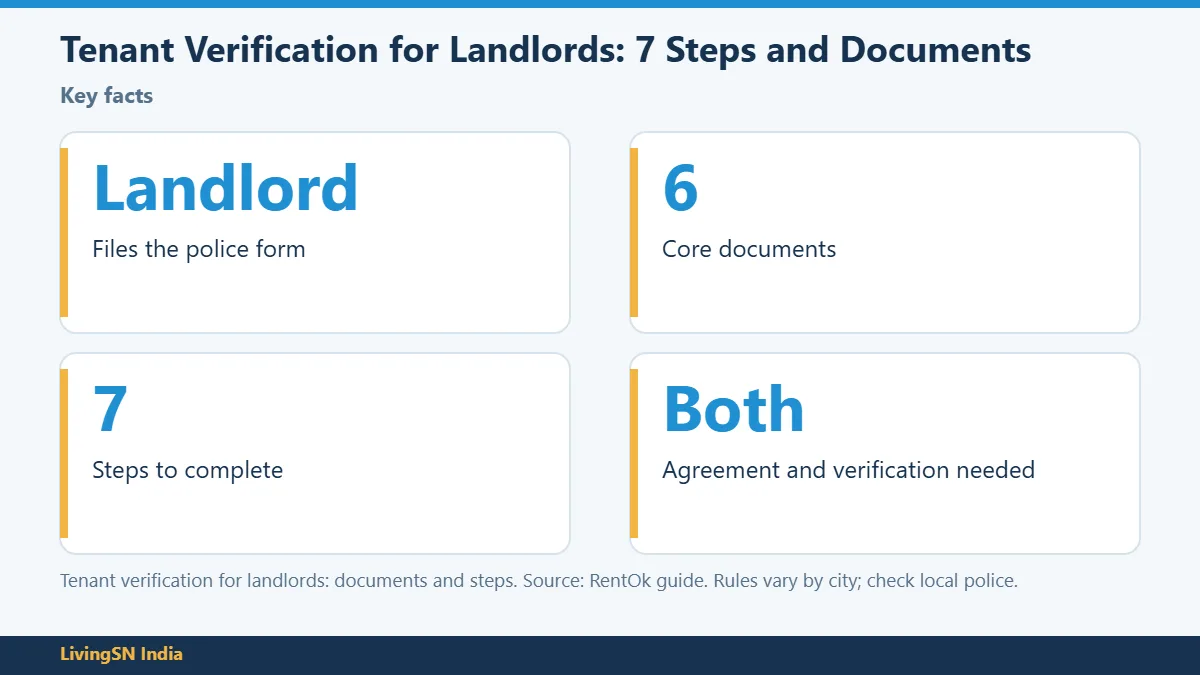
RentOk says the landlord files the verification and also provides their own details. Some brokers and platforms help with the form, but the legal responsibility sits with the owner.
What documents are required for tenant police verification?
A filled form, a signed rent agreement, the tenant’s ID and permanent address proof, a recent photograph and the landlord’s ID proof, per RentOk. Check your local portal for extra requirements.
Can I do tenant police verification online?
Many cities have an online portal. RentOk describes the steps: find the tenant verification section, fill the form, upload documents, submit, pay any fee, track by reference ID and download the report. In Mumbai the section is called kirayedar verification.
How long does tenant verification take?
The time depends on the city and police station. Track the application with the reference ID and keep the acknowledgement.
Does tenant verification replace a rent agreement?
No. Verification informs the police about the tenant; the rent agreement sets rent, deposit, notice and house rules. A landlord should have both.
More rental guides: Flat for Rent in New Delhi: Cost, Locations & Tenant Tips for 2026; Best Areas to Rent a Flat in Noida in 2026.
Related Reading and Sources
- Flat for Rent in New Delhi: Cost, Locations & Tenant Tips for 2026
- Best Areas to Rent a Flat in Noida in 2026
- Rent Agreement in India: Format, Registration and Tenant Checklist
- Security Deposit Rules for Rental Flats in India: 2026 Guide
- How to Rent Out Your Flat Fast in India: 9-Step Landlord Checklist
- Process and documents: RentOk, tenant police verification guide.
- Mumbai process: NoBroker.
- Collect ID, address proof and a photograph from every adult tenant.
- File the police verification form on your local portal.
- Store the agreement, acknowledgement and receipts together.
Own a flat to rent out?
Start with the free trial: up to 10 properties and 1 featured listing for 2 months.
Start free trialWant help managing tenants?
Private Landlords plan: ₹5,000 for 2 months, 20 properties and 5 featured listings.
See landlord plans

Join The Discussion