


How to prepare your flat for rent is a question every owner should answer before the first photo is taken, because a clean, safe, well-documented flat rents faster and attracts better tenants. This guide turns Housing.com’s landlord advice into a 12-point checklist covering inspection, repairs, cleaning, safety, papers, the agreement, tenant checks and pricing, and adds our own view on what is worth spending on. Costs and rules vary by city and building, so treat the numbers as indicative. Sources were checked on 19 November 2026.
How to Prepare Your Flat for Rent: The 12-Point Checklist
This checklist follows Housing.com’s landlord guide (published 16 September 2024, updated 6 August 2025).
- Inspect the whole flat. Walk through every room and note faults a tenant would notice.
- Fix the basics. Repair structural faults, leaks, wiring problems and broken appliances.
- Test plumbing and electricals. Check taps, drains, switches and the geyser so there are no leaks or outages after move-in.
- Deep clean. A professional clean gives a strong first impression, as Housing.com notes.
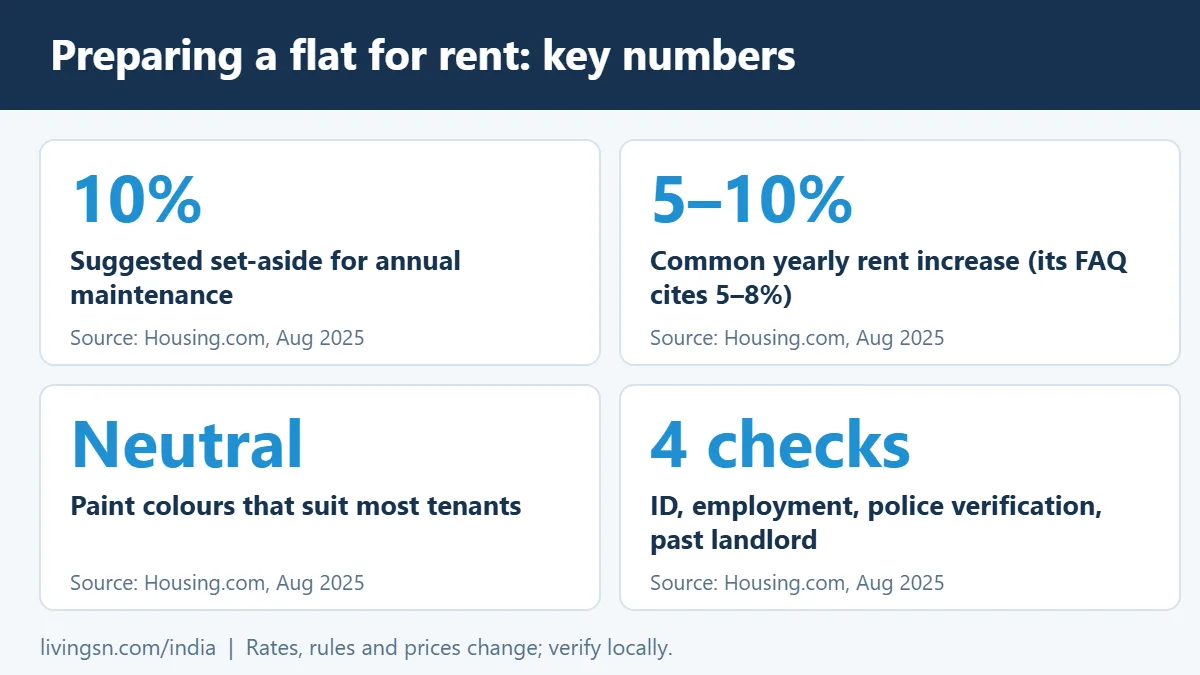
- Repaint in neutral colours. Bold shades may not suit every tenant.
- Replace only what is worn. Update tired fixtures, the kitchen or bathrooms if that supports a higher rent; skip luxury upgrades.
- Secure the flat. Fit sturdy locks on doors and windows. Housing.com also suggests exterior cameras installed before the tenant moves in.
- Gather ownership papers. Keep the sale deed, property tax receipts and possession certificate ready, plus the society NOC if applicable.
- Keep utility bills handy. Electricity and water bills help verify the address and connections.
- Consider insurance. Property insurance can cover damage or loss.
- Write the agreement. Cover rent, deposit, tenancy dates, how often rent rises and each side’s duties, and notarise it. See our rent agreement checklist.
- Verify the tenant and price the flat. Collect ID, income proof, previous address and rental history, run police verification and set a rent from local comparables.
What Is Worth Spending On?
This table is our own view of where money works hardest. Housing.com recommends repairs and a deep clean but does not rank them.
| Spend | Why | Priority |
|---|---|---|
| Leaks, wiring, plumbing | A tenant will find these in the first week | Must do |
| Deep clean and neutral paint | Cheap, and it improves every photo | High |
| Locks and basic security | Protects the flat and the tenant | High |
| Modular kitchen or new bathroom | Only if the old one is poor and rents nearby justify it | Check rent first |
| Luxury fittings | Rarely repaid by rent in a standard flat | Usually skip |
Before you decide on furniture, read our guide to furnished vs unfurnished flat for rent.
Screen the Tenant Properly
Housing.com’s tenant checks include full details such as ID, employment and income proof, previous address and rental history, a police verification through the local police station, confirming employment with the employer, contacting previous landlords and looking for inconsistencies in documents. If your flat is in a society, check whether it has extra verification rules. Our guide to tenant verification for landlords explains the police form step by step.
Price It and Plan for Costs
Research local rents, demand and vacancy and then set a competitive price. Housing.com suggests setting aside about 10% for annual maintenance costs and says a 5% to 10% yearly increase is common, while its FAQ cites 5% to 8%, which varies by city and negotiation. Build the increase into the agreement. Our guide to how to set rent for your flat shows a five-step method, and the security deposit guide explains deposits.
Photograph and List the Flat
Once the flat is ready, take clear photos with our property photography tips and write the ad with the help of our guide on how to write a property listing description. Then follow our 9-step landlord checklist to rent quickly.
- Listing before the repairs are done.
- Using bold wall colours that narrow your tenant pool.
- Skipping the written agreement.
- Taking ID copies but not verifying them.
- Setting rent from a neighbour’s “word of mouth” instead of live ads.
Frequently Asked Questions
How do I prepare my flat for rent?
Inspect it, fix leaks, wiring and appliances, deep clean, repaint in neutral colours, secure the doors, gather your papers, write an agreement, verify the tenant and set a realistic rent.
Should I paint before renting?
Housing.com suggests repainting in neutral colours because bold shades may not suit every tenant. A fresh coat also improves your photos.
What documents should a landlord keep ready?
The sale deed, property tax receipts, a possession certificate if applicable, a society NOC, and electricity and water bills, according to Housing.com.
How much should I set aside for maintenance?
Housing.com suggests about 10% for annual maintenance costs. Your building and flat age will change this.
How much can I increase the rent each year?
Housing.com says 5% to 10% is common and its FAQ cites 5% to 8%. Write the increase into the agreement.
Do I need police verification for my tenant?
Housing.com lists police verification through the local police station among its tenant checks. Rules differ by city, so check your local police portal.
Related Reading and Sources
- How to Rent Out Your Flat Fast in India: 9-Step Landlord Checklist
- Furnished vs Unfurnished Flat for Rent: Landlord Guide
- Rent Agreement in India: Format, Registration and Tenant Checklist
- How to Set Rent for Your Flat in India: 2026 Guide
- Landlord checklist (updated 6 August 2025): Housing.com, things to know before renting out a property in India.
- Inspect the flat and book repairs and a deep clean.
- Gather your papers and draft the agreement.
- Take photos and list with a realistic rent.
Own a flat to rent out?
List it free for 2 months: up to 10 properties and 1 featured listing.
Start free trial



Join The Discussion