

Documents required to sell a flat in India are the papers a buyer, their bank and the sub-registrar use to confirm that you own the flat, that it is free of loans and disputes and that it can legally be transferred. Missing papers are one of the main reasons a sale slows down. This guide explains each document in plain words, groups them so you can collect them in order and shows how a complete set shortens the buyer’s checks. It follows a 20-item checklist from Housing.com and the seller advice in a July 2026 Square Yards guide. Requirements vary by state and bank, so confirm the final list with your buyer’s lawyer. Sources were checked on 19 November 2026.
Documents Required to Sell a Flat in India: The Core Set
This table follows Housing.com’s checklist (updated 16 October 2025), grouped by purpose.
| Document | What it shows | Who issues it |
|---|---|---|
| Title deed | You own the flat and can transfer it; includes ownership history | Your earlier registered deed |
| Sale deed (your own) | How and when you acquired the flat | Sub-registrar |
| Encumbrance certificate | No registered loans or liabilities on the flat | Sub-registrar’s office |
| Society NOC | Society approves and your dues are cleared | Housing society or RWA |
| Society share certificate | You are a member and own the unit | Housing society |
| Completion certificate | Construction matches approved plans | Municipal authority |
| Occupancy certificate | The building is fit for occupation | Municipal authority |
| Property tax receipts and utility bills | Taxes and dues are paid | Local body and utilities |
| Loan clearance letter | Any loan is repaid and the bank has no claim | Your lender |
| ID and address proof | Your identity and current address | You |
Documents That Apply Only in Some Cases
Housing.com also lists papers that depend on your situation:
| Document | When you need it |
|---|---|
| Succession certificate | Inherited flat with no will |
| Possession letter | To show when the original buyer received possession from the developer |
| Power of attorney | Someone else signs for you; it must be executed and notarised |
| Letter of allotment | Flat allotted through a development authority or housing scheme |
| Agreement to sell | Pre-sale terms before the final deed; registering it adds legal weight |
| Indemnity bond | Title gaps, lost originals or inheritance cases |
| Records of major repairs | To support your asking price and buyer confidence |
| Mutation register extract | Obtained after registration to update revenue records |
Housing.com’s full list also covers independent-house and agricultural-land papers, which a flat seller usually does not need.
How Fresh Should Your Encumbrance Certificate Be?
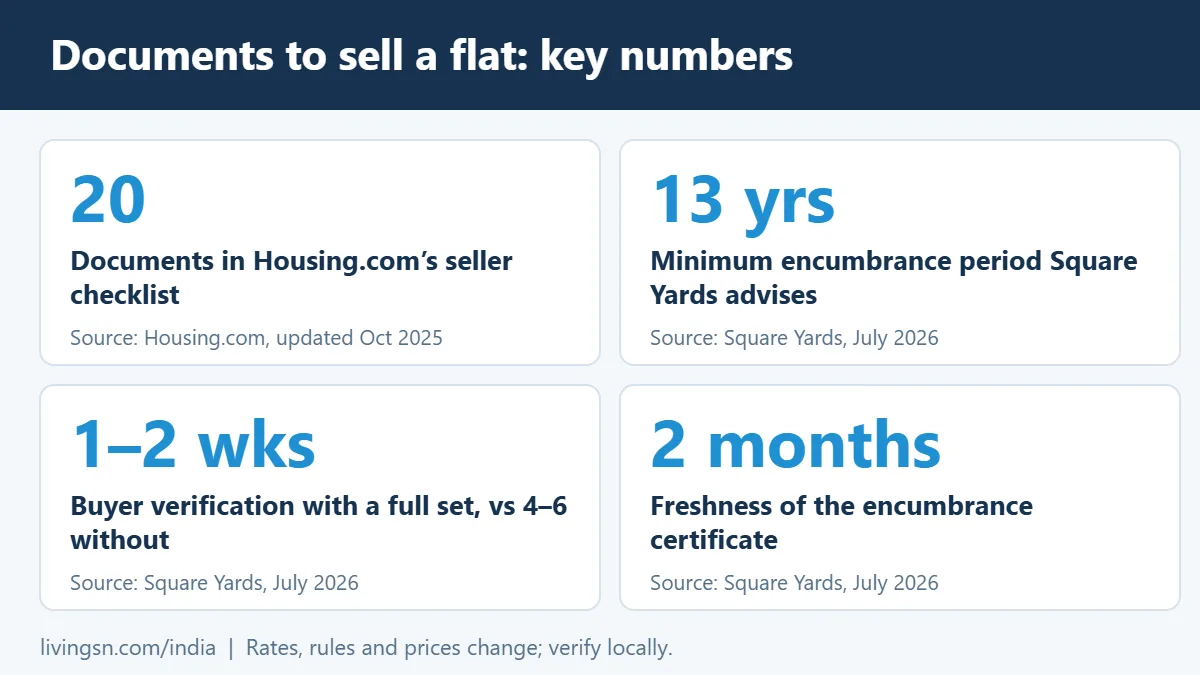
Housing.com says an encumbrance certificate covers a set period, typically 10 to 30 years. Square Yards advises one covering at least 13 years and pulled within the last two months. Because requirements vary by state and bank, ask your buyer or their lawyer what period they want and get the latest certificate.
Why a Full Set Sells Faster
Square Yards says having the sale deed, occupancy certificate, encumbrance certificate, society no-dues and three years of property tax receipts ready can cut buyer verification from four to six weeks to one to two weeks in many cases. It also says clearing a home loan before listing removes three to four weeks from the timeline. For the rest of the plan, read how to sell your flat fast in India.
How to Collect and Organise Your Documents
- Make a checklist. Copy the two tables above and tick off what you have.
- Request society papers first. NOC, share certificate and no-dues often take longest.
- Apply for a fresh encumbrance certificate. Do it within two months of listing, as Square Yards advises.
- Collect loan papers. Get the closure letter and original documents if a loan was cleared.
- Gather tax and utility receipts. Keep property tax and utility bills up to date.
- Scan everything. Housing.com recommends keeping both digital and physical copies and setting reminders for expiring certificates.
Once the papers are ready, plan your tax. See capital gains tax on sale of a flat. Buyers will budget for stamp duty, so you can mention in your ad that documents are ready; our guide on writing a property listing description shows how.
Frequently Asked Questions
What documents are required to sell a flat in India?
Title deed, sale deed, encumbrance certificate, society NOC and share certificate, completion and occupancy certificates, property tax receipts and utility bills, loan clearance letter if applicable, and ID and address proof. Housing.com lists 20 in total.
What is an encumbrance certificate and do I need one?
It shows that the flat has no registered loans or liabilities. Buyers and banks usually ask for it. Square Yards advises one covering at least 13 years and pulled within two months.
Do I need a society NOC to sell my flat?
Housing.com says the NOC confirms society approval and cleared dues, and buyers often require it.
What if I inherited the flat?
Housing.com notes that a succession certificate may be needed when there is no will. Speak to a lawyer for your case.
Can someone else sell my flat on my behalf?
Housing.com says a power of attorney can let an agent handle the sale, but it must be executed and notarised and should state the agent’s powers.
Does a full document set really speed up the sale?
Square Yards says a complete set can cut buyer verification from four to six weeks to one to two weeks in many cases.
Related Reading and Sources
- How to Sell Your Flat Fast in India: 2026 Owner Guide
- Capital Gains Tax on Sale of Flat in India: 2026 Guide
- Stamp Duty on Flat Purchase: 10 States Compared (2026)
- Home Loan Eligibility for a Flat: Income, CIBIL, Documents
- Document list (updated 16 October 2025): Housing.com, checklist of 20 documents for selling a property.
- Encumbrance certificate and verification time (7 July 2026): Square Yards, how to sell a house quickly in India.
- Tick off the core set and the conditional papers that apply to you.
- Apply for a fresh encumbrance certificate and the society NOC.
- Scan everything and keep a digital and a paper copy.
Own a flat to sell?
List it free for 2 months: up to 10 properties and 1 featured listing.
Start free trialLooking to buy a flat?
Browse flats for sale on LivingSN and ask sellers about their papers.
Browse flats for sale

Join The Discussion