

The flat registration cost is the bill most buyers forget until the last week. In Bangladesh you pay several government charges on top of the flat price before the deed is registered in your name, and together they can add close to a tenth of the price. This guide explains each charge, shows worked examples, and tells you how to budget for 2026.
Flat Registration Cost in Bangladesh 2026: The Short Version
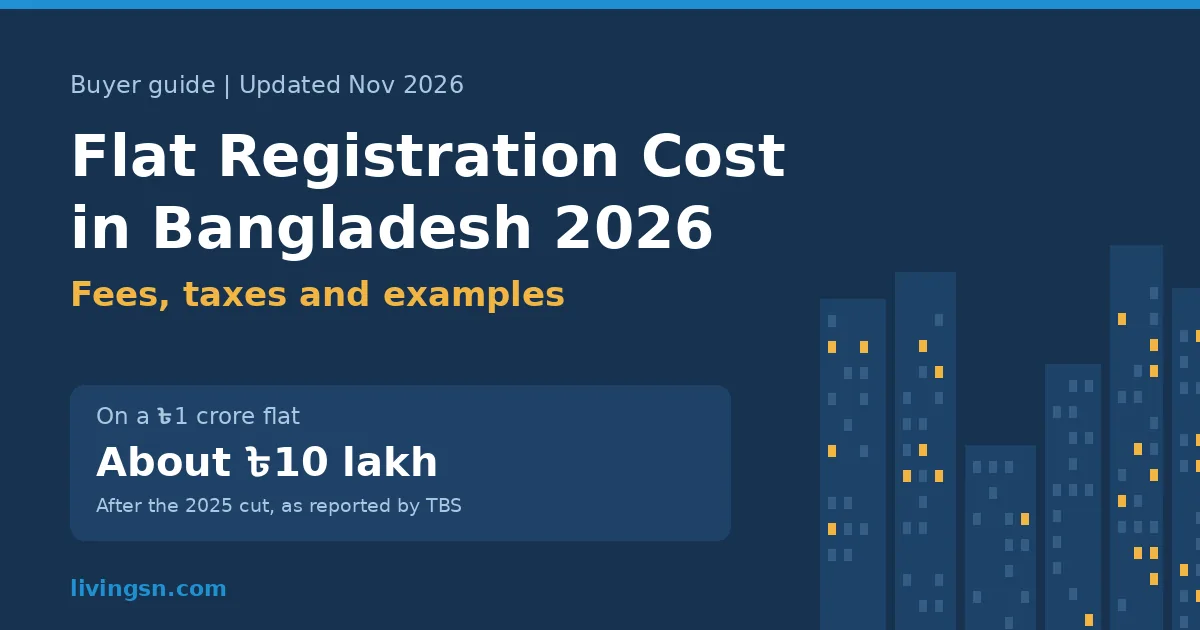
Plan for a flat registration cost of about 10% of the deed value. That is the level reported after the government’s latest cut: according to The Business Standard, a buyer of a Tk1 crore land or flat now pays about Tk10 lakh as registration cost, including stamp duty, registration fee, VAT and local government tax, compared with about Tk14 lakh the previous year.
The exact amount depends on where the flat is, its size, whether you buy from a developer or a private owner, and the source tax set for that area. Use the figures in this guide to build a budget, then ask the sub-registry office or your lawyer for the final calculation before you sign.
Registration cost on a Tk1 crore flat
Before and after the government cut, as reported by The Business Standard
The Charges That Make Up Flat Registration Cost
Registration is not one fee. It is a bundle of separate government charges, each paid through a bank chalan or pay order before the deed is registered. Legal guides such as this 2026 overview of Bangladesh registration fees list the main components below.
| Charge | Commonly cited rate | Usually paid by | Notes |
|---|---|---|---|
| Registration fee | 1% of deed value | Buyer | Paid to the sub-registry |
| Stamp duty | 1.5% of deed value | Buyer | Rules have changed over the years; confirm the current rate |
| Local government tax | 2% to 3% of deed value | Buyer | Depends on city corporation, cantonment or other area |
| Source tax (gain tax) | Varies by area and mouza | Linked to the seller | Set by NBR; cut in the 2025-26 budget |
| VAT on new flats | Depends on flat size | Buyer, via developer | Applies to flats sold by VAT-registered developers |
| Deed writing and small fees | Fixed amounts | By agreement | Deed writer, copies, e-registration service |
Rates are indicative and change with budgets and NBR orders. Confirm current figures at the sub-registry office or with a property lawyer before you pay.
Registration fee
The registration fee is the charge for recording the sale deed at the sub-registry office. It is commonly 1% of the deed value, and the 2025-26 budget reduced the maximum fee in some areas.
Stamp duty
Stamp duty is a tax on the sale document itself. For flats it is commonly cited at 1.5% of the deed value, though older rules and some calculators show higher rates, which is why you must confirm the figure on the day.
Local government tax
This tax goes to the local authority where the flat is located. Guides commonly cite 2% for city corporation and cantonment areas and up to 3% elsewhere.
Source tax on gain
The National Board of Revenue collects income tax at source when property is transferred. In fiscal year 2023-24 this tax was doubled from 4% to 8% of deed value, and registrations fell sharply, according to The Financial Express. It has since been cut and is now set by area.
VAT on developer flats
If you buy a new flat from a developer, VAT is added, and the rate commonly depends on whether the flat is above or below a size threshold. Ask for VAT to be shown as a separate line in the developer’s cost sheet.
Worked Examples of Flat Registration Cost
These examples use the commonly cited rates above to show how the flat registration cost adds up. They are estimates for budgeting only.
| Item | Tk50 lakh flat | Tk80 lakh flat | Tk1 crore flat |
|---|---|---|---|
| Registration fee (1%) | Tk50,000 | Tk80,000 | Tk1,00,000 |
| Stamp duty (1.5%) | Tk75,000 | Tk1,20,000 | Tk1,50,000 |
| Local government tax (2%) | Tk1,00,000 | Tk1,60,000 | Tk2,00,000 |
| Subtotal of these three | Tk2,25,000 | Tk3,60,000 | Tk4,50,000 |
| Plus VAT and source tax | Ask lawyer | Ask lawyer | Ask lawyer |
| Reported all-in level | – | – | About Tk10 lakh |
The three fixed-rate charges come to 4.5% of the deed value. The rest of the bill comes from VAT on developer flats and the area-based source tax, which is why the all-in figure for a Tk1 crore flat is close to Tk10 lakh.
What Changed in 2025
Registration costs were cut in the 2025-26 budget. The Dhaka Tribune reported on 2 June 2025 that, depending on the area, the maximum registration fee was cut by up to 2%, fees and taxes would be set per shatangsha instead of per katha, and the capital gains tax collected at source on land transfers was reduced by area to encourage registration at the actual sale price.
For buyers, the practical result is a lower total flat registration cost than in 2023 and 2024, and less reason to under-declare the price. Rules can change again in a future budget, so always check the latest notice.
Resale Flat vs New Flat: How the Cost Differs
The flat registration cost is not the same for every purchase. When you buy a resale flat from a private owner, you usually pay the registration fee, stamp duty and local government tax, while the source tax on gain is linked to the seller. Developer VAT normally does not apply. When you buy a new flat from a VAT-registered developer, VAT is added to the price, so the total cost is higher for the same deed value.
Joint-venture flats, where a landowner and a developer share the building, can involve extra paperwork such as the developer’s power of attorney. Ask your lawyer to confirm that the seller named on the deed has the legal right to transfer the flat, and that the building matches the approved plan, before you pay any charge.
How Flat Registration Works, Step by Step
- Check documents first. Have a lawyer check the title deed, mutation, land tax receipts and the RAJUK approved plan. Our guide to property laws every buyer should know explains why.
- Agree the deed value. Both sides agree the price that will be written in the deed.
- Get the cost calculated. Ask the deed writer or lawyer to calculate every charge for that area.
- Pay through the bank. Pay stamp duty, fees and taxes by chalan or pay order and keep every receipt.
- Sign at the sub-registry. Buyer and seller sign the deed in front of the sub-registrar with their ID.
- Apply for mutation. After registration, apply to update the land records in your name.
Other Costs to Budget Beyond Registration
- Parking: often priced separately from the flat.
- Utility connections: electricity, water and gas transfer or new connection charges.
- Service charge and common fund: many buildings ask new owners for a deposit.
- Legal fees: for document checks and deed drafting.
- Loan costs: processing fees if you take a home loan. See our home loan guide.
- Interior work: new flats often need fittings, wardrobes and kitchen work.
A simple rule: keep at least 12% to 15% of the flat price aside for registration and these extras, then adjust once you have the exact quote.
Costly Mistakes to Avoid
These mistakes can raise your flat registration cost or put your ownership at risk.
- Under-declaring the price to save tax, which can cause legal and loan problems later.
- Paying fees in cash to an agent instead of through bank chalans with receipts.
- Not confirming who pays which charge before the registration day.
- Registering without checking mutation and land tax records.
- Forgetting VAT when buying from a developer.
- Delaying mutation after registration.
Comparing flats? Our Uttara price guide shows how to estimate the flat price itself, and our step-by-step buying guide covers the full process.
Frequently Asked Questions
How much does flat registration cost in Bangladesh?
For most buyers the total flat registration cost is close to 10% of the deed value. The Business Standard reported that a buyer of a Tk1 crore flat now pays about Tk10 lakh in stamp duty, registration fee, VAT and local government tax, down from about Tk14 lakh before the cut.
What is the stamp duty on a flat in Bangladesh?
Legal guides commonly cite stamp duty of 1.5% of the deed value for a flat sale, alongside a 1% registration fee and a 2% to 3% local government tax. Rates and calculation rules have changed several times, so confirm the current figure at the sub-registry office before you budget.
Who pays the registration cost, the buyer or the seller?
In most flat sales the buyer pays stamp duty, the registration fee and the local government tax, while the source tax on gain is linked to the seller’s side of the deal. Who pays what can be changed by agreement, so write it clearly in the sale agreement before registration.
Is VAT charged when buying a flat from a developer?
Yes. When a VAT-registered developer sells a new flat, VAT is added to the price, and the rate commonly depends on the flat’s size. Resale flats bought from an individual owner are usually not charged this developer VAT. Ask the developer for a written cost sheet showing VAT separately.
Did the government reduce registration costs in 2025?
Yes. In the 2025-26 budget the government cut land registration costs, reducing the maximum registration fee by up to 2% depending on the area and lowering the capital gains tax collected at source, according to the Dhaka Tribune. The aim was to encourage registration at the actual sale price.
Can I lower my registration cost by declaring a lower price?
Do not under-declare. Under-declaring creates legal risk, can cause problems with bank loans and resale, and recent reforms aim to align deed values with market prices. Declaring the real price protects your ownership and your tax records. Ask a lawyer to check the declared value.
Sources
- All-in cost on a Tk1 crore flat: The Business Standard.
- 2025-26 budget changes: Dhaka Tribune, 2 June 2025.
- Source tax history: The Financial Express.
- Component rates: registration fee overview, 2026.
- Keep 12% to 15% of the price aside for registration and extras.
- Get every charge calculated by a lawyer or deed writer.
- Pay only through bank chalans and keep all receipts.

Join The Discussion