

Rental income tax for landlords in India is calculated under the head “Income from House Property,” and most owners are surprised by how much of their rent can be deducted before tax. You get a flat 30 percent standard deduction, you can deduct municipal taxes you actually paid and you can claim home loan interest on a let-out flat. This guide explains each step with a worked example for a ₹25,000 monthly rent, notes what the sources do not cover and points you to a chartered accountant for your own return. Sources were checked on 19 November 2026.
How Rental Income Is Taxed
BeyondWalls and Kanakku Pillai (10 May 2025) both say rent is taxed under Income from House Property, added to your total income and taxed at the slab rate. The tax is based on gross annual value, which is the higher of actual rent received or the expected rent. If a flat is genuinely offered for rent but stays vacant for part of the year, BeyondWalls says that vacancy is allowed for in the calculation.
Step-by-Step Calculation
- Start with the annual rent. Monthly rent multiplied by 12.
- Deduct municipal taxes paid. Only taxes actually paid during the year count. The result is the net annual value (NAV).
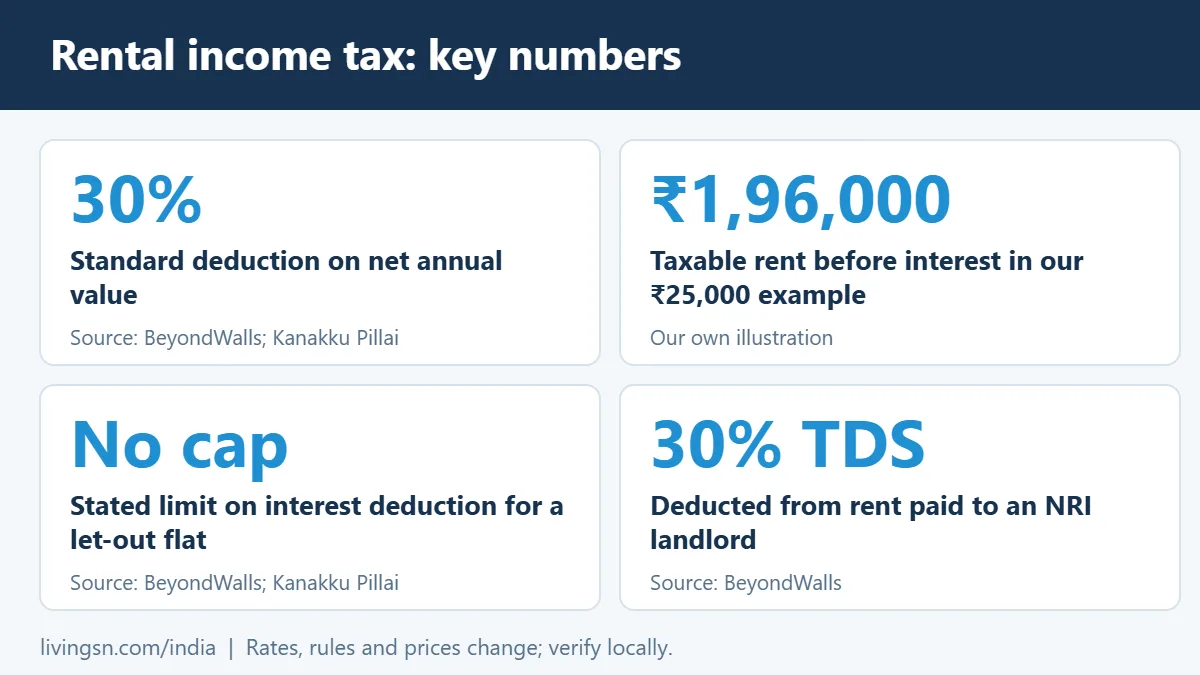
- Deduct the 30% standard deduction. Under Section 24(a) it is 30% of NAV, fixed whatever you actually spend and without bills.
- Deduct home loan interest. Both sources say there is no stated upper limit on interest for a let-out flat. Check the rules on setting off a loss against other income.
- Add the result to your other income. It is taxed at your slab rate.
Worked Example: ₹25,000 a Month
BeyondWalls uses this example, and we added the final step.
| Step | Amount |
|---|---|
| Annual rent (₹25,000 × 12) | ₹3,00,000 |
| Municipal taxes paid | ₹20,000 |
| Net annual value | ₹2,80,000 |
| 30% standard deduction | ₹84,000 |
| Taxable rent before interest (our calculation) | ₹1,96,000 |
| If home loan interest is ₹1,00,000 (our illustration) | ₹96,000 |
Kanakku Pillai gives a similar example: ₹20,000 monthly rent and ₹10,000 municipal tax leave a net annual value of ₹2,30,000, a deduction of ₹69,000 and taxable rent of ₹1,61,000. Your own figures will differ.
If You Are an NRI Landlord
BeyondWalls says the tenant must deduct TDS at 30% before paying rent to an NRI, and that a refund can be claimed if the actual tax is lower. The sources we read give no rent threshold for TDS and do not cover TDS paid by resident tenants or GST on rent, so we do not state any figures for those. Ask your accountant.
Records Every Landlord Should Keep
- Rent receipts and bank statements. Pay and receive rent by bank transfer so there is a clear record.
- Municipal tax receipts. Only taxes actually paid count towards the deduction.
- Home loan certificate. Your lender’s interest certificate supports your claim.
- The signed agreement. See our rent agreement checklist.
- Tenant verification and deposit records. See our guides on tenant verification and security deposits.
Better rent starts with a realistic price; read how to set rent for your flat. This is general information, not tax advice.
Frequently Asked Questions
How is rental income taxed in India?
Under Income from House Property. You deduct municipal taxes paid, a 30% standard deduction on net annual value and home loan interest, and the balance is taxed at your slab rate.
What is the standard deduction on rent?
30% of net annual value under Section 24(a). It is fixed and does not need bills, according to Kanakku Pillai and BeyondWalls.
Can I claim home loan interest on a rented flat?
Both sources say there is no stated upper limit on interest for a let-out flat. Check loss set-off rules with your accountant.
Is TDS deducted on rent?
BeyondWalls says the tenant deducts 30% TDS when the landlord is an NRI. We did not verify thresholds for resident tenants, so ask your accountant.
Do I pay tax if the flat is vacant?
BeyondWalls says part-year vacancy is allowed for flats genuinely offered for rent. Keep proof of your efforts to find a tenant.
Do I need to report rent in my income tax return?
Yes. Rent is part of your income. File it under Income from House Property and keep your records.
Related Reading and Sources
- How to Set Rent for Your Flat in India: 2026 Guide
- Rent Agreement in India: Format, Registration and Tenant Checklist
- Tenant Verification for Landlords: 7 Steps and Documents
- Security Deposit Rules for Rental Flats in India: 2026 Guide
- Calculation, example and NRI TDS (page shows 2026): BeyondWalls, rental income taxation FY 2025-26.
- Standard deduction and example (10 May 2025): Kanakku Pillai, how much rent income is tax-free in India.
- Add up a year of rent and municipal taxes paid.
- Apply the 30% deduction and your home loan interest.
- Keep receipts and ask an accountant to check your return.
Own a flat to rent out?
List it free for 2 months: up to 10 properties and 1 featured listing.
Start free trialManaging several flats?
Private Landlords: ₹5,000 for 2 months, 20 properties and 5 featured listings.
See landlord plans


Join The Discussion