


Capital gains tax on sale of flat in India depends on how long you held the flat, when you bought it and what you do with the money afterwards. Since the July 2024 rule change, many sellers can no longer assume the lower rate means a lower bill, and older flats may qualify for a choice between two methods. This guide explains the main rules in plain words using a Business Today article dated 22 July 2026, shows its worked example and lists the exemptions you can ask your accountant about. It is general information, not tax or legal advice, and rules change often. Sources were checked on 19 November 2026.
Capital Gains Tax on Sale of Flat in India: The Core Rules
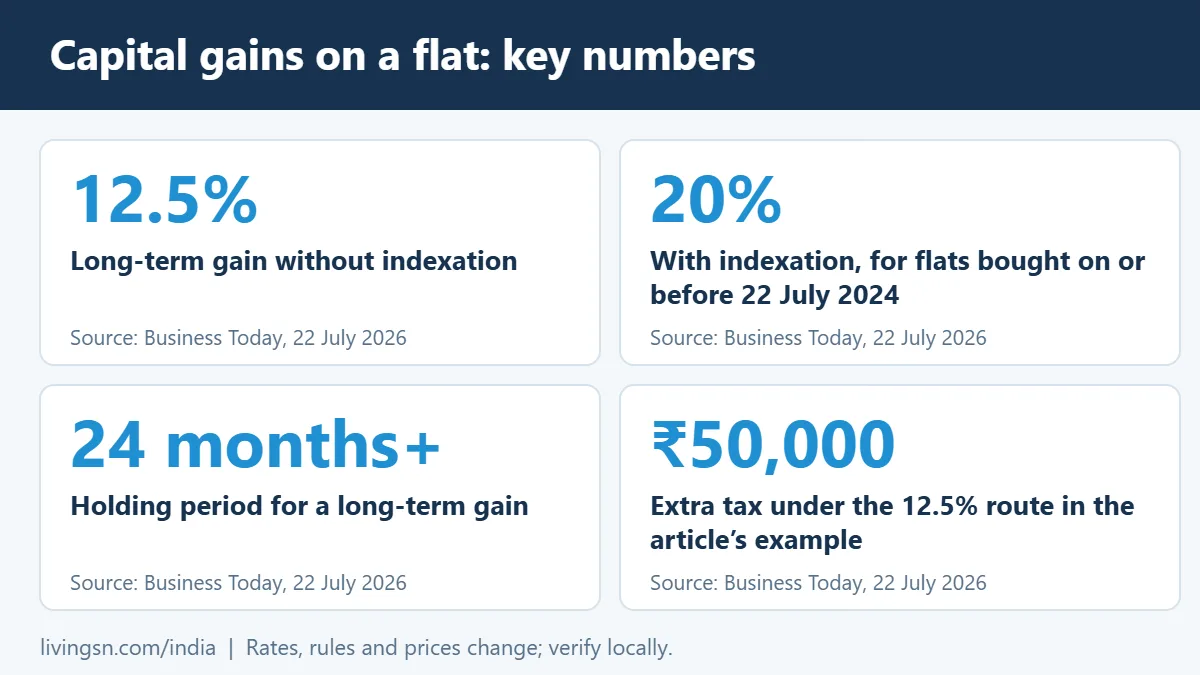
Business Today gives these points as of July 2026.
| Question | Answer |
|---|---|
| When is the gain long-term? | When the property is held for more than 24 months before transfer |
| Long-term rate | 12.5% without indexation |
| Flats acquired on or before 22 July 2024 | Resident individuals and HUFs can choose the lower of 20% with indexation or 12.5% without indexation |
| Flats acquired on or after 23 July 2024 | No indexation |
| Exemptions | Section 54 (reinvest in another residential house) and Section 54EC (specified capital gains bonds), subject to conditions and timelines |
The article does not cover short-term gains. In general, a gain on a flat sold within 24 months is short-term and is added to your income and taxed at your slab rate, but confirm this with your accountant.
Worked Example: Why 12.5% Is Not Always Cheaper
Business Today’s example: a flat bought in 2010 for ₹50 lakh and sold in 2026 for ₹1.5 crore, with an assumed indexed cost of ₹90 lakh.
| Method | Taxable gain | Tax |
|---|---|---|
| 20% with indexation | ₹60 lakh | ₹12 lakh |
| 12.5% without indexation | ₹1 crore | ₹12.5 lakh |
The seller pays ₹50,000 more under the lower rate because indexation is lost. The article’s lesson is that a lower tax rate does not always mean lower taxes. If your flat qualifies for the choice, ask your accountant to compute both.
Exemptions to Ask Your Accountant About
The same article names two routes. Section 54 allows an exemption when the gain is reinvested in another residential house. Section 54EC allows an exemption when the gain is invested in specified capital gains bonds. Both come with conditions and timelines, and the article does not state limits, so we do not quote any here. Check the exact rules, amounts and deadlines before you sell, because missing a deadline can cost you the exemption.
Steps to Plan Your Capital Gains Tax
- Work out the holding period. Count from the date you acquired the flat to the date of transfer and check whether it passes 24 months.
- Collect cost records. Keep the original purchase deed, stamp duty and registration receipts, and records of major improvements.
- Check the acquisition date. If you bought on or before 22 July 2024, ask for the tax to be computed both ways.
- Decide on reinvestment. Compare Section 54 and Section 54EC with your plans and the deadlines.
- Budget for the tax. Set aside the tax before you spend or reinvest the sale money.
- Report it correctly. Show the sale in your income tax return and keep proof for several years.
Mistakes Sellers Make
- Assuming 12.5% is always lower than the older 20% with indexation.
- Missing the 24-month holding period by a few weeks.
- Not keeping the purchase deed and improvement receipts.
- Spending the sale money before checking reinvestment deadlines.
- Relying on a blog, including ours, instead of an accountant.
Before you sell, prepare your papers using our list of documents required to sell a flat in India and follow our guide on how to sell your flat fast in India. Buyers will budget for stamp duty, and some are comparing buying with renting; see buying vs renting a flat in India.
Frequently Asked Questions
What is the capital gains tax on sale of a flat in India?
Business Today (22 July 2026) says long-term gains, for flats held more than 24 months, are taxed at 12.5% without indexation. Older flats may be taxed at 20% with indexation if that is lower.
What is the holding period for a flat?
More than 24 months makes it long-term, according to the article. Shorter holding gives a short-term gain, usually taxed at slab rates; confirm with your accountant.
Can I still use indexation on a flat?
For flats acquired on or before 22 July 2024, resident individuals and HUFs can choose the lower of 20% with indexation or 12.5% without it. For flats acquired on or after 23 July 2024, indexation is not available.
How can I save capital gains tax on a flat?
The article names Section 54 (reinvest in another residential house) and Section 54EC (specified bonds), subject to conditions and timelines. Ask an accountant about limits.
Is the 12.5% rate always better?
No. In the article’s example the 12.5% route cost ₹50,000 more than 20% with indexation, because indexation was lost.
Should I hire a chartered accountant?
Yes for any large sale. Tax rules change and your facts matter, so confirm the numbers before you sign the sale deed.
Related Reading and Sources
- How to Sell Your Flat Fast in India: 2026 Owner Guide
- Documents Required to Sell a Flat in India: 2026 List
- Stamp Duty on Flat Purchase: 10 States Compared (2026)
- Buying vs Renting a Flat in India 2026
- Rates, indexation choice, exemptions and example (22 July 2026): Business Today, why the new 12.5% capital gains tax may not always reduce your tax bill.
- Confirm your holding period and acquisition date.
- Ask your accountant to compute both methods if you bought on or before 22 July 2024.
- Check Section 54 and 54EC deadlines before you spend the proceeds.
Own a flat to sell?
List it free for 2 months: up to 10 properties and 1 featured listing.
Start free trial


Join The Discussion