

Home loan eligibility for a flat depends on your age, income, credit score, existing EMIs, job stability and the value of the flat you want to buy. Banks check each of these before they decide how much they will lend. This guide uses the State Bank of India criteria published by NoBroker as an example, explains the FOIR rule with a worked example, lists the loan-to-value limits and shows the documents salaried and self-employed buyers usually need. Banks change criteria often, so treat all numbers as indicative. Sources were checked on 7 November 2026.
Home Loan Eligibility for a Flat: The Main Criteria
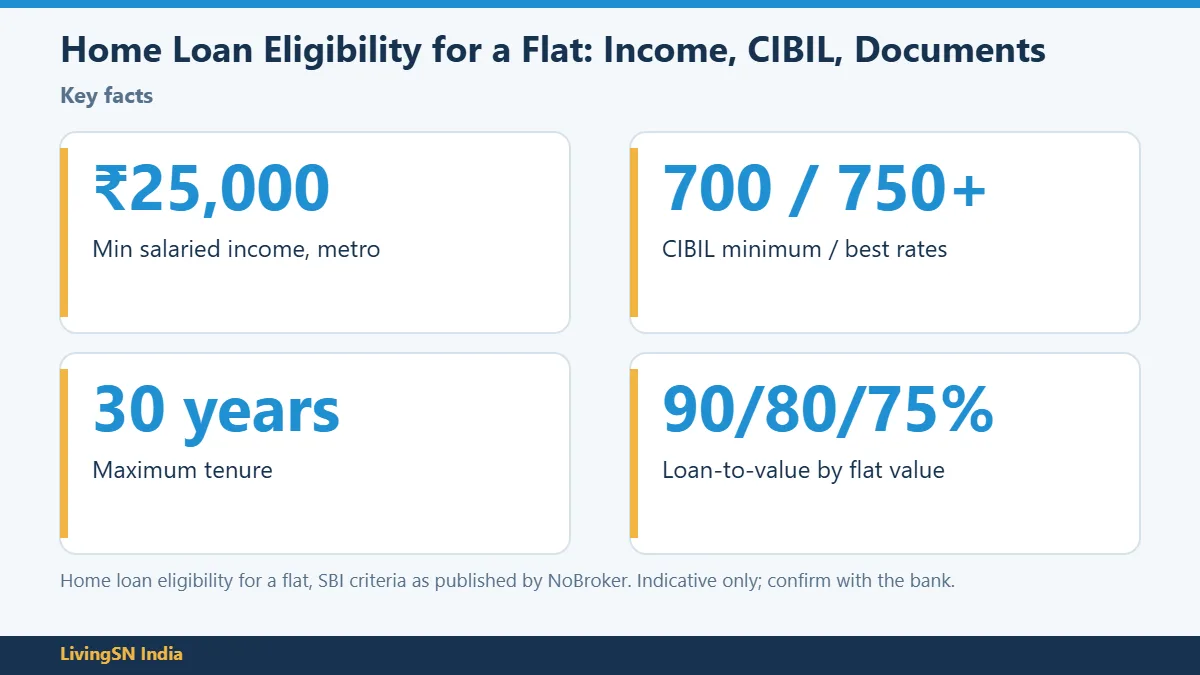
The figures below come from NoBroker’s SBI eligibility page, which says they are indicative and that SBI’s actual criteria may vary. Other banks use similar tests with different numbers, so check your lender’s current rules.
| Factor | SBI, as published by NoBroker |
|---|---|
| Age | Minimum 18; maximum 70 at loan maturity; NRIs up to 60; pensioners up to 75 |
| Maximum tenure | 30 years |
| Minimum income, salaried | ₹25,000 a month in metros; ₹15,000 in non-metro areas |
| Minimum income, self-employed | ₹50,000 a month in metros; ₹25,000 in non-metro areas |
| CIBIL score | Minimum 700; 750 or higher for the best rates (the page also lists 750 as the requirement, so confirm with the bank) |
| Employment, salaried | Permanent job; about 2 years of experience; 6 months to 1 year with the current employer |
| Employment, self-employed | 3 years of business or practice; profit in the last 2 years; 3 years of ITRs |
FOIR: How Much EMI Can You Afford?
FOIR means fixed obligations to income ratio. It is the share of your monthly income that goes to all EMIs, including the new home loan. NoBroker’s page lists these ranges for SBI: 40%–50% for net monthly income below ₹30,000, 50%–55% for ₹30,000–₹50,000, 55%–60% for ₹50,000–₹1,00,000 and 65%–70% above ₹1,00,000.
Example (our own illustration): if your net income is ₹80,000 a month and the FOIR is 55%–60%, your total EMIs can be about ₹44,000–₹48,000. If you already pay ₹8,000 in other EMIs, your new home loan EMI could be about ₹36,000–₹40,000. Your bank will decide the final amount, so use a lender’s calculator.
The simplest way to improve home loan eligibility for a flat is to close small loans and card balances before you apply, because they reduce the EMI room the bank sees.
Loan-to-Value: How Much Down Payment You Need
The loan-to-value ratio caps the share of the flat’s value that the bank will finance. NoBroker lists SBI limits of 90% for property up to ₹30 lakh, 80% for above ₹30 lakh and up to ₹75 lakh, and 75% above ₹75 lakh.
| Flat value | Maximum loan | Minimum down payment |
|---|---|---|
| Up to ₹30 lakh | 90% | 10% |
| Above ₹30 lakh to ₹75 lakh | 80% | 20% |
| Above ₹75 lakh | 75% | 25% |
Remember to budget for stamp duty and registration on top of the down payment. See our stamp duty comparison.
Documents for Home Loan Eligibility
| Applicant | Documents usually asked |
|---|---|
| Salaried | Last 6 months’ salary slips, Form 16 for 2 years, 6 months’ salary account statement, employment letter, appointment or increment letter |
| Self-employed | ITR with computation for 3 years, audited balance sheet and P&L for 3 years, 6 months’ current account statement, GST returns and business registration |
| All applicants | Photo ID (PAN, passport, voter ID or Aadhaar), address proof and 3 passport photographs |
The bank will also ask for property papers such as the sale agreement and title documents, so choose a flat with a clear title and a registered seller.
How to Improve Your Home Loan Eligibility for a Flat
- Check your credit report. Fix errors and pay overdue dues so your score reaches 750 or higher.
- Reduce existing EMIs. Prepay or close small loans to raise your FOIR room.
- Add a co-applicant. A working spouse or parent can raise combined income, subject to the bank’s rules.
- Stay in a stable job. Banks check how long you have worked with your current employer.
- Save a larger down payment. A bigger down payment lowers the loan and the EMI.
- Apply with complete documents. Missing papers slow approval.
Frequently Asked Questions
What is the home loan eligibility for a flat in India?
Banks check age, income, credit score, existing EMIs, job stability and the flat’s value. For SBI, NoBroker lists a minimum salaried income of ₹25,000 in metros, an age limit of 70 at maturity and a CIBIL score of 700 or above, with 750 or higher for the best rates.
What CIBIL score is needed for a home loan?
NoBroker’s SBI page says the bank requires a minimum of 700 and that 750 or higher qualifies for the best rates, though another table on the page lists 750. Confirm the cutoff with your bank.
What is FOIR in a home loan?
FOIR is the share of your monthly income that goes to all fixed EMIs. For SBI, NoBroker lists ranges from 40%–50% at lower incomes to 65%–70% above ₹1,00,000 a month.
How much down payment is needed for a flat?
NoBroker lists SBI loan-to-value limits of 90% up to ₹30 lakh, 80% above that up to ₹75 lakh and 75% above ₹75 lakh, so the minimum down payment is 10%, 20% or 25% respectively.
Can a self-employed person get a home loan?
Yes. SBI asks for 3 years of business or practice, profit in the last 2 years and 3 years of ITRs, with a minimum income of ₹50,000 a month in metros, per NoBroker.
Do banks lend for under-construction flats?
Many banks do, with stage-wise disbursement, but rules vary. Check the project’s approvals and RERA status with your lender before you apply.
Next, compare your options: Buying vs Renting a Flat in India 2026; How to Choose Between Buying and Renting a Flat in India’s Metro Cities (2026 Guide); Top Indian Cities to Buy Property in 2026: Delhi, Hyderabad, Kolkata or Bangalore?; Top 5 Areas to Buy Property in Hyderabad for High ROI (2026 Guide).
Related Reading and Sources
- Buying vs Renting a Flat in India 2026
- How to Choose Between Buying and Renting a Flat in India’s Metro Cities (2026 Guide)
- Top Indian Cities to Buy Property in 2026: Delhi, Hyderabad, Kolkata or Bangalore?
- Top 5 Areas to Buy Property in Hyderabad for High ROI (2026 Guide)
- Stamp Duty on Flat Purchase: 10 States Compared (2026)
- Rent Agreement in India: Format, Registration and Tenant Checklist
- 2BHK Rent in Mumbai Suburbs: Andheri to Thane 2026 Rates
- SBI criteria: NoBroker, SBI home loan eligibility (figures indicative).
- General eligibility: Square Yards.
- Check your credit score and clear overdue payments.
- Estimate your EMI room using the FOIR range for your income.
- Collect salary or ITR documents and compare two or three banks.
Looking to buy a flat?
Browse flats for sale on LivingSN and shortlist homes within your budget.
Browse flats for saleOwn a flat to sell or rent?
List it free for 2 months: up to 10 properties and 1 featured listing.
Start free trial


Join The Discussion